
How to tell if a rug is handmade or machine made
You can usually tell if a rug is handmade or machine made by checking the backing, edges and individual knots. Handmade rugs have irregular knots tied by hand into a woven foundation and a fabric or stitched backing, while machine-made rugs show straight, uniform rows on the reverse with a glued or woven backing. Turn the rug over and look closely at the construction details before buying.
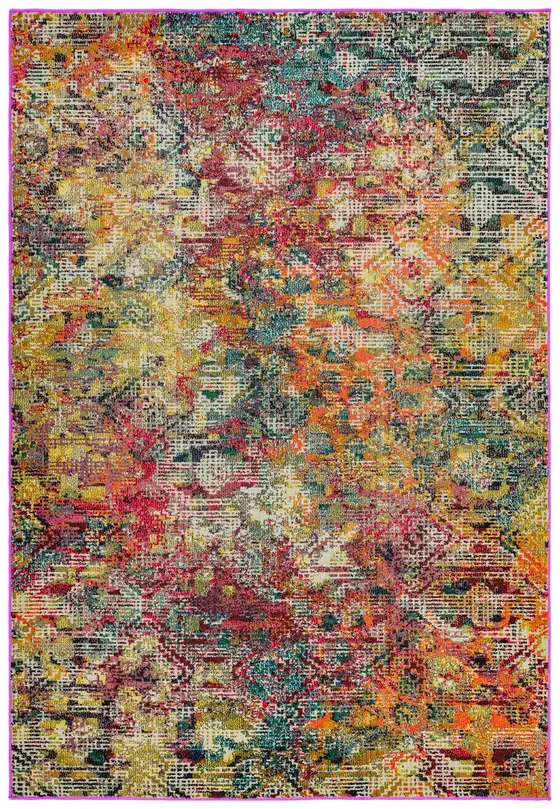
Backing and reverse side
The quickest way to identify construction is to flip the rug and examine the back. A handmade rug normally has a fabric or canvas backing with visible knots that are slightly uneven in size and spacing. Machine-made rugs usually show perfectly straight lines of yarn and often have a stiff, uniform backing that may feel glued or laminated.
Hand-knotted rugs have individual knots tied around the warp threads, so the reverse often looks like a mirror image of the front but with natural variations. Machine-woven rugs produce consistent loops or cuts across the entire width because they are made on power looms.
What to check on the reverse
- Are the rows perfectly straight and evenly spaced?
- Is there a visible glue or latex layer?
- Do the colours on the back match the front exactly?
If the answers are yes, the rug is almost certainly machine made. For comparison, view our range of handmade rugs which are all constructed without glue on the reverse.
Fringe and selvedge edges
Fringe is another reliable indicator. On a handmade rug the fringe is usually an extension of the warp threads and is an integral part of the construction. Machine-made rugs often have fringe that is sewn or glued on afterwards, so it may look attached rather than growing out of the rug itself.
Selvedges (the long sides) on handmade pieces are typically overcast or reinforced by hand, giving a slightly irregular but sturdy finish. Machine rugs have very neat, uniform edges produced by the loom. This difference is especially clear on wool rugs because natural fibre shows slight thickness variations that machines cannot replicate.
Explore wool rugs to see both handmade and machine-made options side by side and compare the edge details.
Knots, pile and texture
Handmade rugs are created by tying individual knots, so the pile height can vary slightly across the surface and the density of knots is never perfectly uniform. Machine-made rugs have pile that is cut or looped at exactly the same height throughout.
Run your hand over the surface. A handmade rug often feels softer with subtle changes in tension, while a machine-made version feels more consistent but can appear flatter over time. Flatweave rugs without pile are harder to judge by touch alone, so always check the reverse.
Our plain and textured rugs include both constructions, allowing you to choose based on the look and feel you prefer for a living room or bedroom.
Labels, materials and construction methods
Product labels and specifications usually state the manufacturing method. Look for terms such as “hand-knotted”, “hand-tufted” or “hand-woven” for handmade rugs. Machine-made rugs are labelled as “machine-woven”, “power-loomed” or simply “machine-made”.
Material choice also gives clues. Many machine-made rugs use polypropylene because it is easy to weave on looms and tolerant of water. Handmade rugs more commonly use wool. However, both constructions appear in modern abstract designs, so always read the full specification on the product page.
See the difference in our modern and abstract rugs collection, where the same pattern is sometimes offered in both handmade and machine-made versions.
Hand-tufted versus hand-knotted
Within handmade rugs there is an important distinction. Hand-knotted rugs have each knot tied individually and are the most labour-intensive. Hand-tufted rugs use a gun to punch yarn through a backing fabric, then a layer of glue is applied to hold the tufts in place. The latter are quicker to produce.
To tell them apart, press the pile. In a hand-knotted rug you can usually feel the foundation weave between the knots. A hand-tufted rug feels more like a dense carpet with a solid backing. Always check the care instructions because hand-tufted rugs with glue are more sensitive to excessive moisture.
Many buyers choose hand-tufted for living rooms where the 160 x 230 cm size is popular because it allows 30–60 cm of floor to show around the edges in most UK rooms.
Practical buying checklist
Use this list when comparing rugs online or in photographs:
- Examine high-resolution images of the reverse side.
- Check whether fringe is woven in or added later.
- Look for natural variations in knot size and row spacing.
- Read the exact construction description on the product page.
- Consider the intended room: machine-made polypropylene rugs suit kitchens and high-traffic areas because they are easier to keep clean.
Following these steps helps you match the rug to your needs, whether you want the durability of a machine-made design or the character of a handmade piece. For larger spaces consider 200 x 290 cm rugs that allow the front legs of a three-seater sofa to sit comfortably on the rug while the rug extends 15–30 cm past each end of the sofa.
Remember that both types have trade-offs. Machine-made rugs offer consistency but can crush over time. Handmade rugs feel more luxurious and age gracefully but require more careful maintenance. The product pages list full details of material, pile height and construction so you can make an informed choice.
Frequently asked questions
Can a machine-made rug look handmade?
Yes. Modern looms can create detailed patterns that imitate hand-knotted looks, especially in abstract or faded designs. The reverse side and edge construction remain the most reliable ways to tell the difference. Always check the product specification which states the manufacturing method.
Are handmade rugs always better quality?
Not necessarily. Quality depends on materials and construction rather than the method alone. A well-made machine-woven wool rug can outlast a poorly finished hand-tufted one. Handmade rugs often have more character, while machine-made ones provide uniformity and easier care.
Do all handmade rugs have fringes?
Most traditional hand-knotted and hand-woven rugs do, because the fringe is formed from the warp threads. Some contemporary handmade designs have the edges finished without visible fringe. In contrast, machine-made fringe is almost always added after weaving.
Is it easy to tell the difference from a photo?
High-resolution photos of the reverse can help, but it is harder than seeing the rug in real life. Look for irregularity in the knots and whether the backing looks woven or glued. The product description on each page clearly states if the rug is handmade or machine made.
Why are handmade rugs more expensive?
They require far more labour. A single hand-knotted rug can take weeks or months depending on size and knot density. Machine-made rugs are produced quickly on looms.
Shop the guide
-
 Hive Wool Rug in Charcoal
from £169.98
-
 Hive Wool Rug in Pink
from £119.98
-
 Hive Wool Runner in Teal
from £119.98
-
 Hive Wool Rug in Rust
from £169.98
Related guides
- Why does my rug smell after getting wet?
- What is the softest rug material?
- What is the most durable rug material?
- Should you rotate a rug, and how often?
- How rugs are made: construction types explained
- All rug guides
Questions about a specific rug? Every product page lists the maker's size, material, pile height and care details. Delivery is free and tracked to England, Wales and mainland Scotland, and you have 14 days to change your mind. See delivery and returns.